Introduction
The University of Michigan is among the top schools for students from outside the United States. Every year, around 2,000 people from a variety of different countries come to Michigan to further pursue their education. However, being thousands of miles away from home is not always easy and a reliable and convenient method of communication is vital. We decided to conduct a study to learn how international students here communicate with their network at home. In particular, we want to understand how technology can be leveraged to mediate global communications and break down barriers. The research questions we are seeking to answer with this study are:
RQ1. How do international students communicate with their network?
RQ2. What factors influence international students’ decision to use a communication channel?
The study lasted two weeks and consisted of 6 different stages: planning interview research, preparing for interviews, interviewing, analysis, personas and scenarios and lastly, this report.
Methods
To implement this study, we first honed in on the University of Michigan’s population of undergraduate international students. Because this population is quite diverse, even having 15 different interviewees was not fully representative of our target population. When recruiting, we had to be conscious of who each of us were interviewing and try to enlarge our pool to include international students from a variety of different countries. We ended up interviewing 15 people from 12 different countries: India, Estonia, Nigeria, Dubai, Bahrain, Brazil, Hong Kong, China, France, Taiwan, Zimbabwe, and Singapore. Of the students, 9 were male and 6 were female.
Initially when brainstorming our interview questions for our interview protocol, we focused our attention on our research questions and tried to create questions that would help answer them. However, we soon realized that the questions were too specific and would place restrictions on the students’ processes of thinking. In order to keep the questions open-ended, we came up with five broad categories within the scope of our research and designed our questions around the categories. The five categories were: communication channels, content of conversation, frequency of communication, audiences, and technology. The communication channels and technology sections were aimed towards answering the first research question while content of conversation, frequency of communication and audiences were more aimed towards answering the second research question. By broadening the focus of the questions, we would be able to elicit more insight surrounding students’ decisions on channel usage and be able to make more meaningful conclusions on their preferences as a whole.
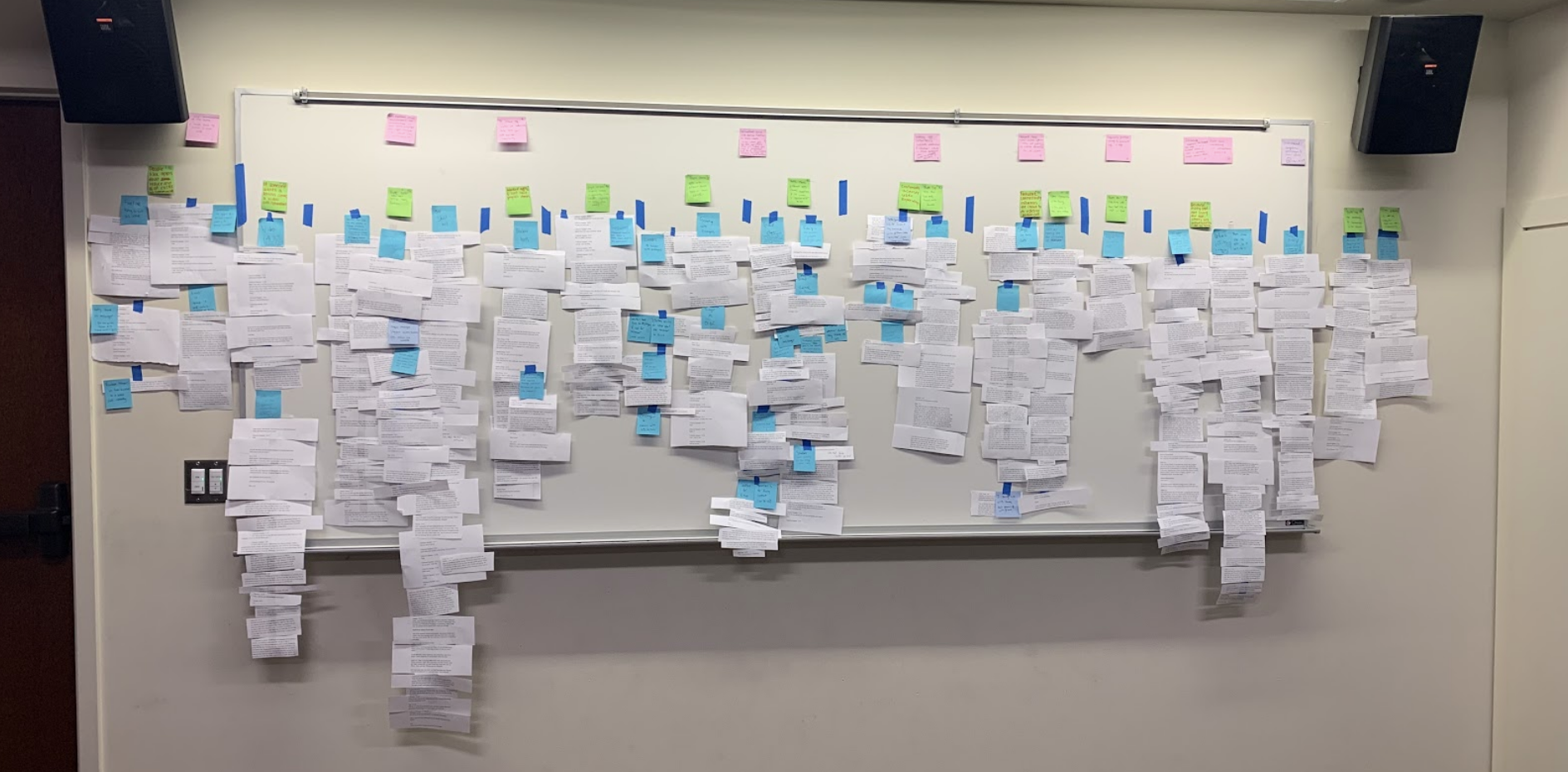
After conducting our interviews, we transcribed and cut them into strips to separate each block of speech. First we combined similar strips to create simple phrases that summarized patterns we recognized in the students’ actions to create the initial level of codes. Some examples of codes we came up with were “dealing with time zone differences” detailing the different ways people navigated around the time difference and “younger vs older” indicating instances different apps when talking to the different age groups of their contacts. Determining these codes allowed us to easily create the next level of insights where we grouped codes together to make broader assumptions. For example, “dealing with time zone differences” went under the insight “time difference is not a stressful experience when communicating” while “younger vs older” fell under the insight “people choose apps with different features based on their audience. We then created overarching recommendations based on the insights to complete our affinity diagram. We will go more in depth regarding our codes, insights and recommendations in the next section.
Findings and Recommendations
Summary Results
Through the creation of our affinity diagram, we identified some patterns regarding the usage of communication channels amongst international students and came up with three main categories of users based on what they value most: (1) students who value efficiency and getting points across quickly, (2) students who value communicating with many people in a wide variety of ways, (3) students who value expression and being able to customize their communication. The following personas detail the characteristics, attitudes, needs and preferences of these three user categories.
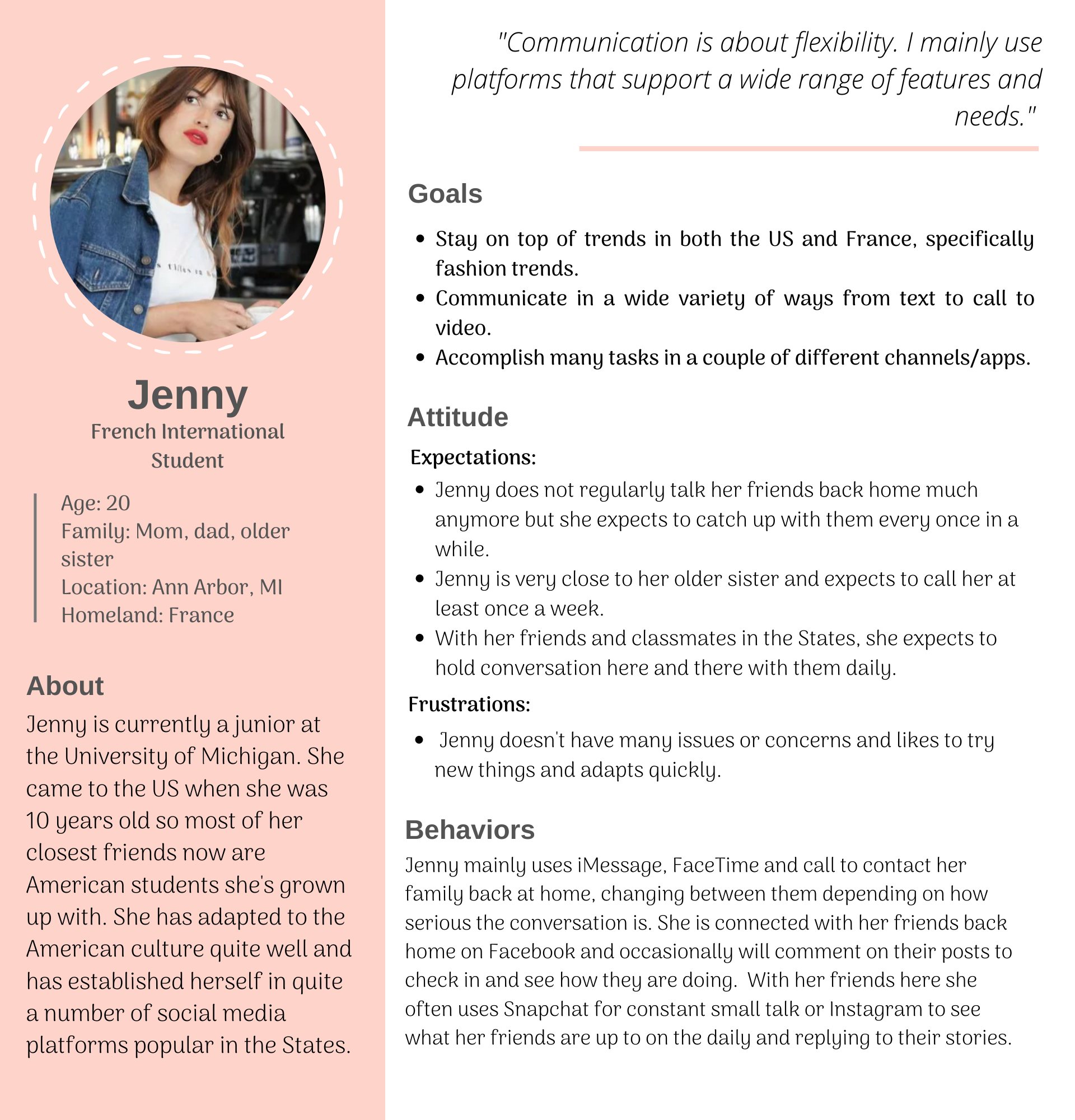
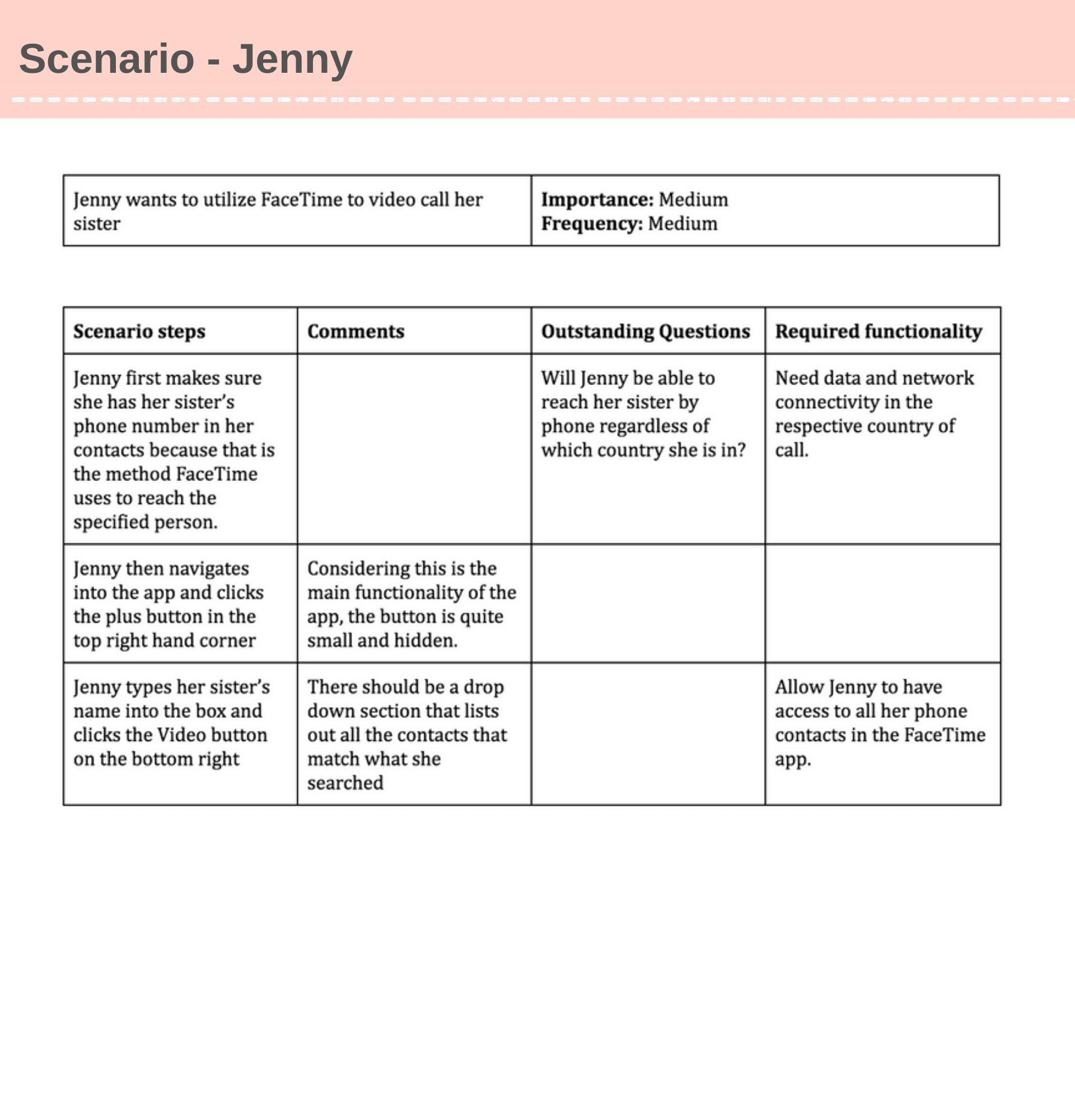
Persona 1 is Jenny, an international student from France. In her scenario, she wants to FaceTime her sister.
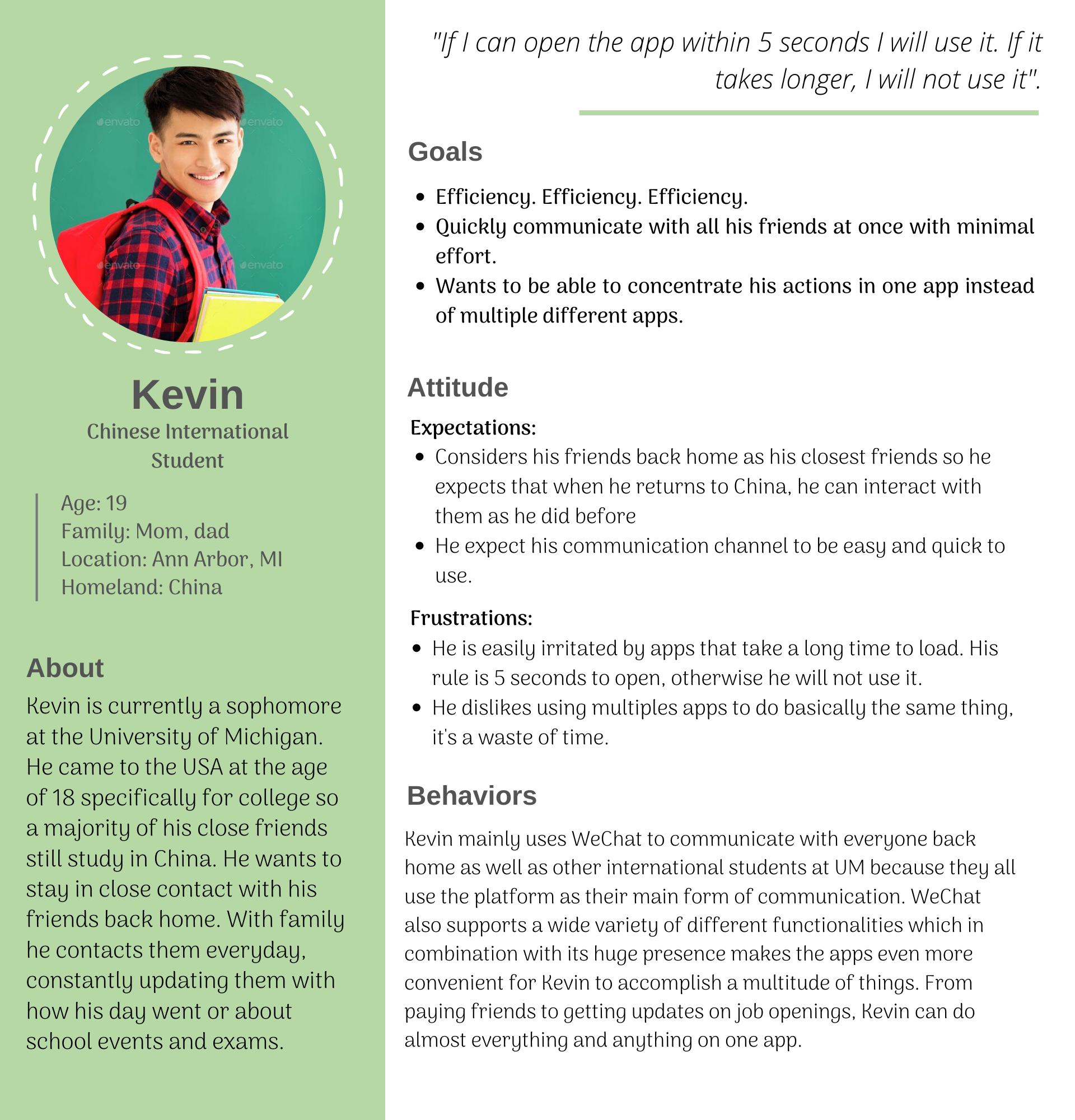
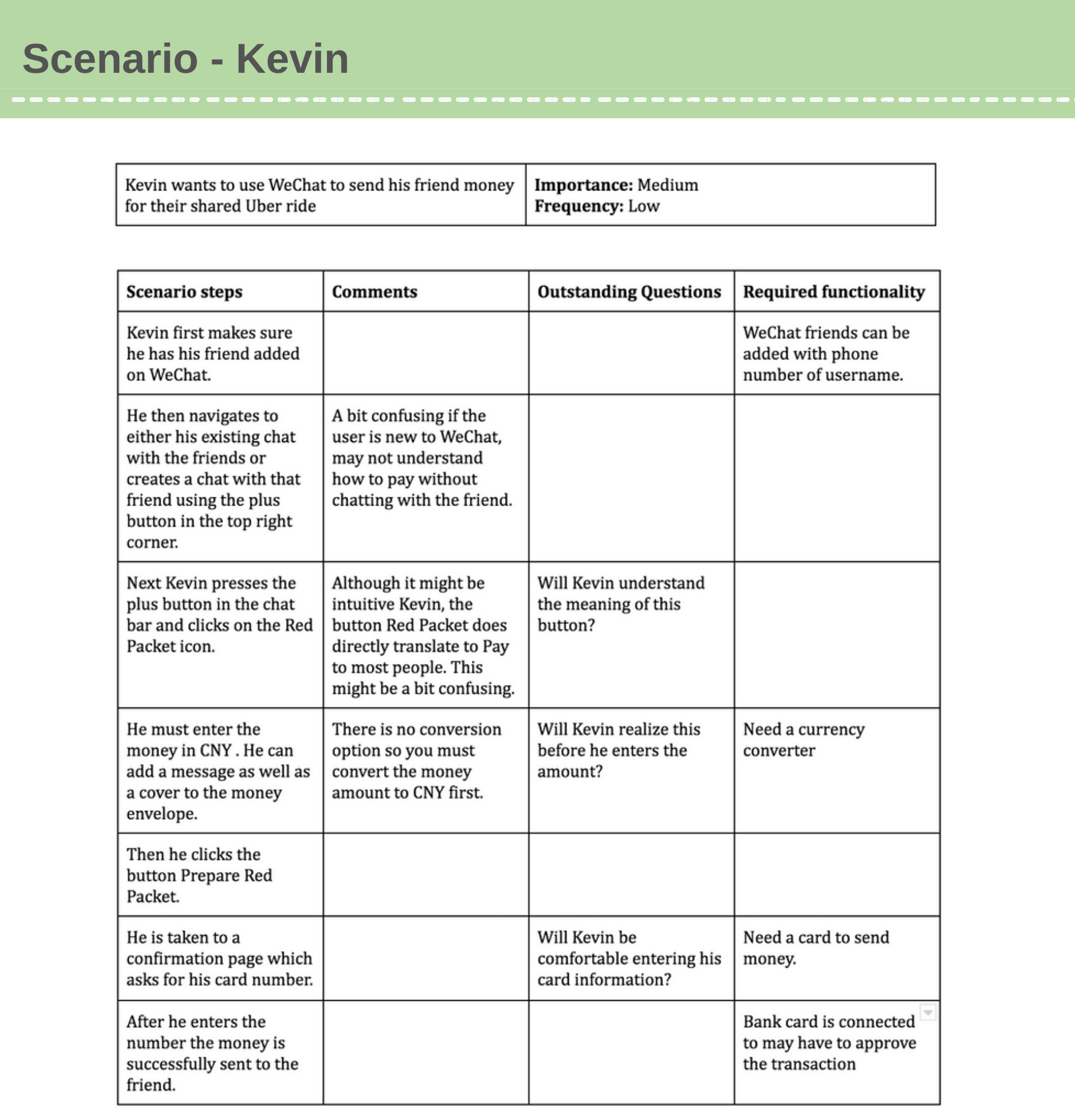
Persona 2 is Kevin, an international student from China. In his scenario, he wants to use WeChat to send his friend money for their shared Uber ride.
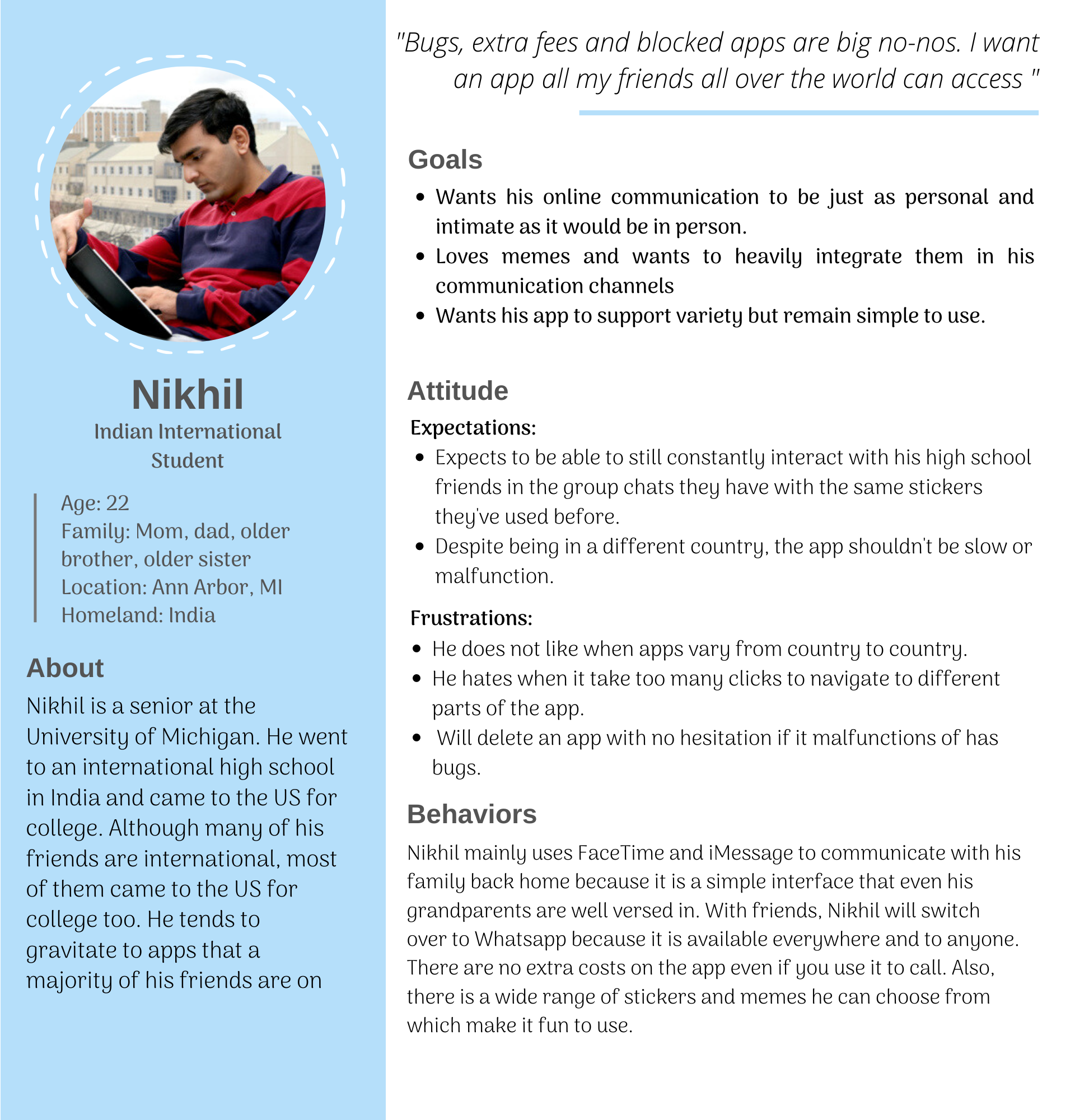
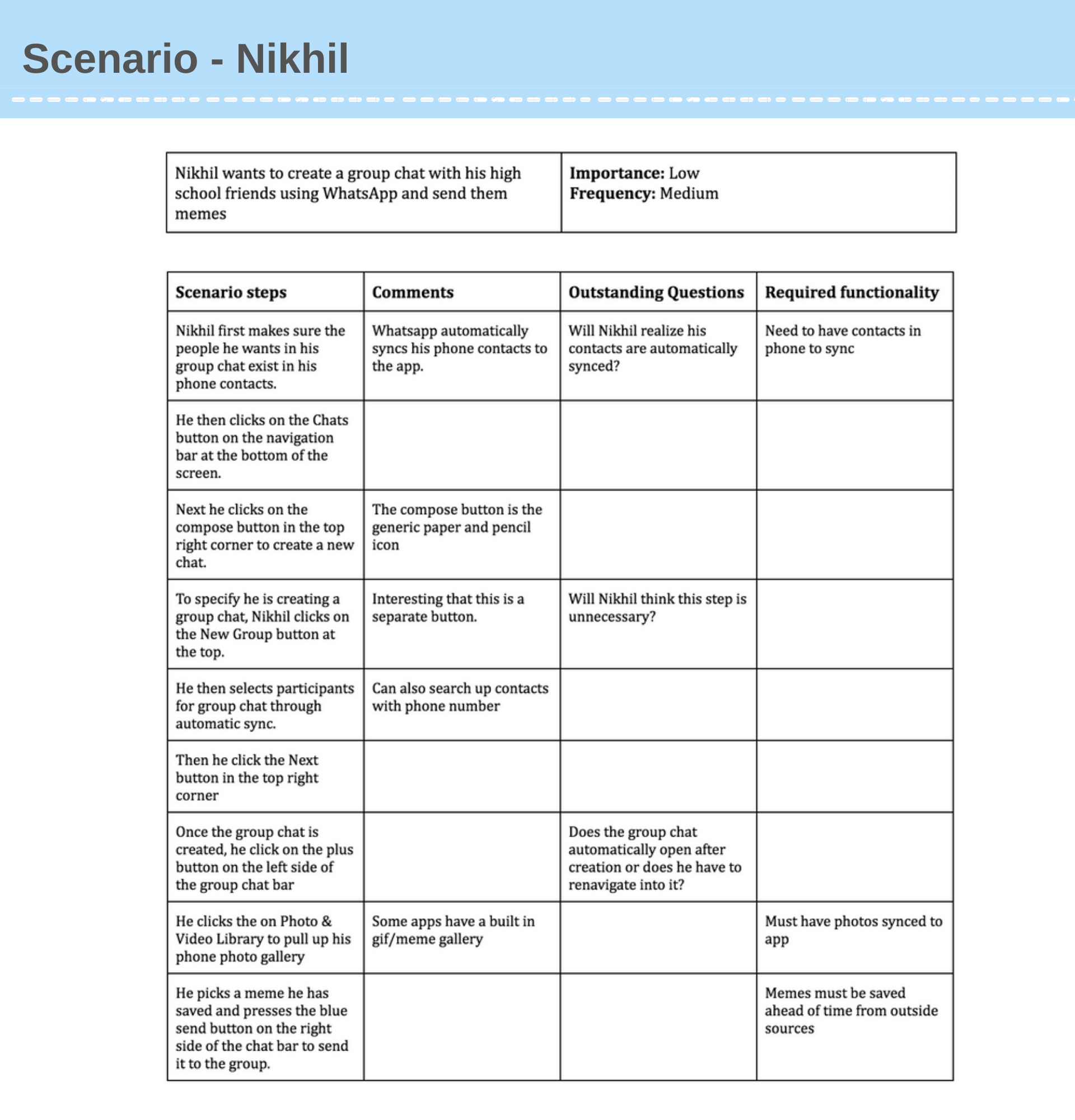
Persona 3 is Nikhil, an international student from India. In his scenario, he wants to use WhatsApp to create a group chat and send memes.
We found that communication is very unique to each individual and that was directly reflected in his or her use of channels and platforms. Depending on what apps their friends were using or how active they were on a platform, the experiences varied immensely. However there were a couple key points we found consistently followed by the students in order to combat common problems they faced when communicating internationally.
Key Findings
In regards to RQ1, “How do international students communicate with their network?”, we only came up with a couple insights because the responses targeted to answer this question were definitely more varied and very dependent on an individual’s schedule and preferences:
- People contact family more consistently than friends
- Time difference is not a stressful experience when communicating
- When communicating with family, video call is the main method
- If someone wants a serious conversation, a video call is standard
- We found that people followed a more rigid schedule when communicating with family and were more sporadic when talking to their friends back home. In regards to the time difference, each person tackled it in a different way but it was never really an issue for anyone.
- These insights were represented in all my personas. For example, Jenny tries to contact her older sister once a week and often uses FaceTime when communicating with her family. Kevin typically contacts his family everyday with iMessage, updating them regarding school events and his exams. Nikhil is very close with his grandparents and video calls them once every two weeks to check in with them and update them on his life.
In regards to RQ2, “What factors influence international students’ decision to use a communication channel?”, we identified many more broad insights that could be grouped together:
- If many people are using the app, others are influenced to do so.
- Blocked apps and cost limit people’s choices
- International students often have friends from all over the world so we found that they preferred concentrating communication to apps that a majority of their friends are using, avoiding apps that are blocked in certain countries. This way, information can travel faster and reach more people amongst all groups with minimal effort.
- Some real life quotes from our interviews that demonstrate this preference are: “Well to be honest WhatsApp is just kind of easy because it’s universal”, “the problem with Skype is not many people use it nowadays and because not many people have it it’s not easy to reach other people by the same platform” and “I’m not going to be using something if I have to like constantly change to another one to reach other people”. Regarding costs, students said “I’d have to pay a fee to text so we all use WhatsApp”.
- I represented this preference with two of my personas, Kevin and Nikhil.
- Kevin recently came to the US so even at UM, he gravitates towards Chinese international students. WeChat is the universal communication platform in China and a majority of Chinese people have some sort of presence on the app. Therefore Kevin can communicate with almost everyone on WeChat.
- Since Nikhil came from an international school, his high school friends are from all over the world. He prefers apps that have an international presence and all his friends can access. He also tries to avoid using apps that don’t operate through the Internet because of hidden costs that may pop up and deter many people from using the app.
- People choose apps with different features based on their audience
- People choose different apps/channels based on if the content is lighthearted or serious
- Because international students deal with many groups of people from various social circles, we found that some need to utilize multiple different apps in order to effectively communicate different things with all their contacts. However, we found that some people may have contradicting views regarding this.
- We identified varying patterns in channel usage that demonstrated these needs from the transcripts. Some examples include “Snapchat is used mainly for fun, silly casual talk with friends” while “Facebook is for general updates and to share with a broad audience” and “Email is for serious updates and connecting with employers”. This shows that each channel has a specific audience it is known to reach and a specific type of content users typically share.
- I represented this need with my persona Jenny.
- As someone who is more integrated with American culture, Jenny utilizes a lot of the popular US channels to communicate but still stays active on popular channels back home. When communicating with her parents, she will often gravitate towards video call or call if the content is more serious and iMessage if the content is more casual. With friends, more serious content regarding the latest news and politics are shared on Facebook while casual updates are posted on Instagram. However we found that this is also heavily influenced by network connectivity.
- People like apps that have more personalization features
- People prefer apps that combine many functions - one shop all.
- Since international students come from all parts of the world, their tastes and preferences range across a wide spectrum. Some may prefer a minimalistic interface while others want to be able to customize and change everything. We found that in this day and age, many students don’t only communicate with words anymore and often utilize stickers and memes to communicate. Being able to completely express themselves is very important and is determined by the personalization made available by the app. This customization also refers to being able to choose from a wide range of features to use or not use.
- Some quotes that demonstrate this are “it really is catered to the younger population because we have animated stickers and you can send gifs” and “it has all the functions that we need in one app… it has specific functions that cater to different age groups”.
- I represented this preference with my personas Nikhil and Kevin.
- Nikhil wants his online communication to be personal and intimate, integrating fun things like memes and stickers into his chat to make them as interactive as they would be if they were in person. Without these personalizations, Nikhil wouldn’t feel the conversation is entirely representative of him.
- As someone who values efficiency, Kevin really appreciates that he can do almost anything on WeChat.
Recommendations
In regards to RQ1, this is the broad recommendation we came up with:
- Understand competitor landscape and their users
- From the insights people contact family more consistently than friends, time difference is not a stressful experience when communicating, when communicating with family, video call is the main method, and if someone wants a serious conversation, a video call is standard, we realized that what determines how international students communicate with their network is very specific to the individual’s needs. Thus we recommend apps to evaluate their competitors and understand their specific users to cater towards the type of communication it is best at providing.
In regards to RQ2, we came up with a couple of recommendations that support the different categories of users we mentioned before:
- Make sure marketing has international presence
- Incentivize referrals to increase user base to hit a threshold number of users to eventually enable network effects
- From the insight, if many people are using the app, others are influenced to do so, we determined that a key component of a good communication app is the number of people on it. When more people are on the app, the value of the service increases and network effects are created to drive better and better communication.
- To increase the number of users, make your app available internationally
- We noticed the insight blocked apps and cost limit people’s choices affected international students that talked to people from all around the world the most. If the app isn’t available internationally or blocked in certain countries, it deters students from using it and prevents network effects from forming.
- Understand users and tailor functions to their needs (know what your app does well/why users will choose you over a competitor and do it well, release updates focused on improving these features)
- From the insights people choose apps with different features based on their audience and people choose different apps/channels based on if the content is lighthearted or serious, we found that when students choose to use multiple apps, it is mainly because they prefer using each app for a different way of communicating. That specific feature is the main driver of the app’s users so we thought it would be important for apps to hone in on that and continually develop their app around that popular feature.
- Add features that complement the communication aspect to keep users engaged with apps longer
- The insight people prefer apps that combine many functions brought to our attention the necessity for apps to have multiple functionalities without overwhelming the user. Students prefer the perfect balance between usability and functionality. There should be a good range of operations that can be run but an easy to use interface should still be kept in place.
- Making apps customizable supports multicultural and individual needs and caters to different aesthetics
- From the insights people like apps that have more personalization features, we realized that since communications apps thrive off of having many users, it must be able to accommodate the differing preferences of so many people.
Conclusion
As more and more students from all over the world come to the US to study, communication channels are being heavily relied on to maintain connection with those back at home. Although it seems like a simple decision, there are a lot of things to take into account when choosing a communication channel to use. From efficiency to customizability, students prioritize a wide variety of different functionalities. By identifying a couple of the most popular functionalities and features and then creating recommendations, we honed in on what makes a communication channel widely used by many people and successful.